
Landoll Trailer Transport
Moving a piece of construction equipment, heavy machinery, a storage container, or a disabled commercial vehicle is different from arranging a standard tow. The load may not fit safely on a conventional flatbed, and it may be too large or awkwardly shaped for a wheel-lift tow truck. In these situations, Landoll trailer transport may provide a practical way to load and move the equipment.
Sun City Towing Inc. provides Landoll transport service for customers throughout the Phoenix Metro area, Maricopa County, and other parts of Arizona based on the details of the move. Our Landoll traveling-axle trailer can be used for planned equipment moves, container transport, machinery relocation, and certain towing or recovery situations.
Our fleet also includes two heavy wreckers, flatbeds, and wheel-lift tow trucks. Having several equipment options allows us to evaluate what needs to be moved and determine whether the job calls for Landoll towing, heavy wrecker service, vehicle recovery, or another transport method.
What Is a Landoll Trailer?
A Landoll is a traveling-axle trailer designed to create a low loading angle. Instead of relying only on fixed ramps, the trailer uses a moving undercarriage and tilting deck to bring the rear portion of the trailer closer to ground level.
This design can make it easier to load equipment with limited ground clearance, machinery that cannot climb steep ramps, and vehicles that are not operating properly. Depending on the load, a winch may also be used to guide the item onto the trailer in a controlled manner.
Landoll Company states that its founder invented the traveling-axle trailer in 1969. The manufacturer’s current traveling-axle lineup includes models ranging from 5-ton to 55-ton capacities and is used across towing, recovery, construction, equipment hauling, rental, and storage-container applications. Exact capabilities vary by trailer model and configuration.
Sun City Towing Inc. reviews the dimensions, weight, condition, and loading requirements of each item before determining whether our Landoll is the right option. We do not assume that every machine or container can be transported in the same way.
What Can Be Moved With Landoll Transport?
One reason Landoll trailers are used in several industries is their versatility. They can accommodate many loads that do not fit neatly into traditional vehicle-towing categories.
Our Landoll transport service may be appropriate for:
- Construction equipment
- Forklifts and material-handling equipment
- Loaders and compact equipment
- Heavy machinery
- Industrial equipment
- Storage or shipping containers
- Disabled commercial vehicles
- Certain buses, trucks, or motorhomes
- Equipment that cannot move under its own power
- Loads that require a lower loading angle
This list is not a guarantee that every item can be transported. Equipment dimensions, total weight, tire or track condition, ground clearance, pickup access, destination access, and securement points can all affect whether a Landoll trailer is suitable.
A machine that appears small may be unusually heavy. A lighter container may still present access challenges because of its length or placement. Providing accurate information before dispatch helps our team plan the move around the actual load rather than relying on assumptions.
Landoll Equipment Transport
Contractors, equipment owners, fleet managers, rental operations, and property managers may need machinery moved for many reasons. A machine may be going to another jobsite, returning to a yard, heading to a repair facility, or being removed from a property.
Landoll equipment transport can be useful when the machinery rolls but does not operate, has low clearance, or cannot safely travel on public roads. The traveling-axle design creates a gradual loading path, while the trailer deck supports the equipment during transportation.
Common examples may include construction machines, forklifts, industrial equipment, and other wheeled or tracked machinery. The correct approach depends on the machine’s weight distribution, attachment position, height, width, and overall condition.
Before pickup, attachments may need to be lowered, folded, disconnected, or positioned to reduce movement. Loose items should be removed or secured, and the destination should have enough space for the truck and trailer to enter, position, unload, and exit.
Container Transport With a Landoll Trailer
Storage and shipping containers present different challenges from vehicles. They do not have wheels, steering, brakes, or a drivetrain, so the loading process must account for the container’s placement, condition, dimensions, and surrounding space.
A Landoll trailer may be used to move an empty or appropriately prepared container from one location to another. The traveling deck and loading system help bring the container onto the trailer without treating it like a conventional vehicle.
Container transport requires more than knowing the pickup and delivery addresses. Our team may need information about:
- The container’s size and estimated weight
- Whether the container is empty or contains materials
- The surface beneath and around it
- Nearby fences, buildings, trees, or utility lines
- Available space for the truck and trailer
- The container’s desired position at the destination
The pickup and delivery areas should be level, firm, and accessible whenever possible. Soft soil, loose gravel, narrow gates, low branches, sharp turns, and overhead obstructions can affect the move.
Customers should also make sure the container is ready for transportation before the scheduled pickup. Items inside should be removed or secured, doors should close properly, and access to the container should remain clear.
Landoll Towing for Disabled Commercial Vehicles
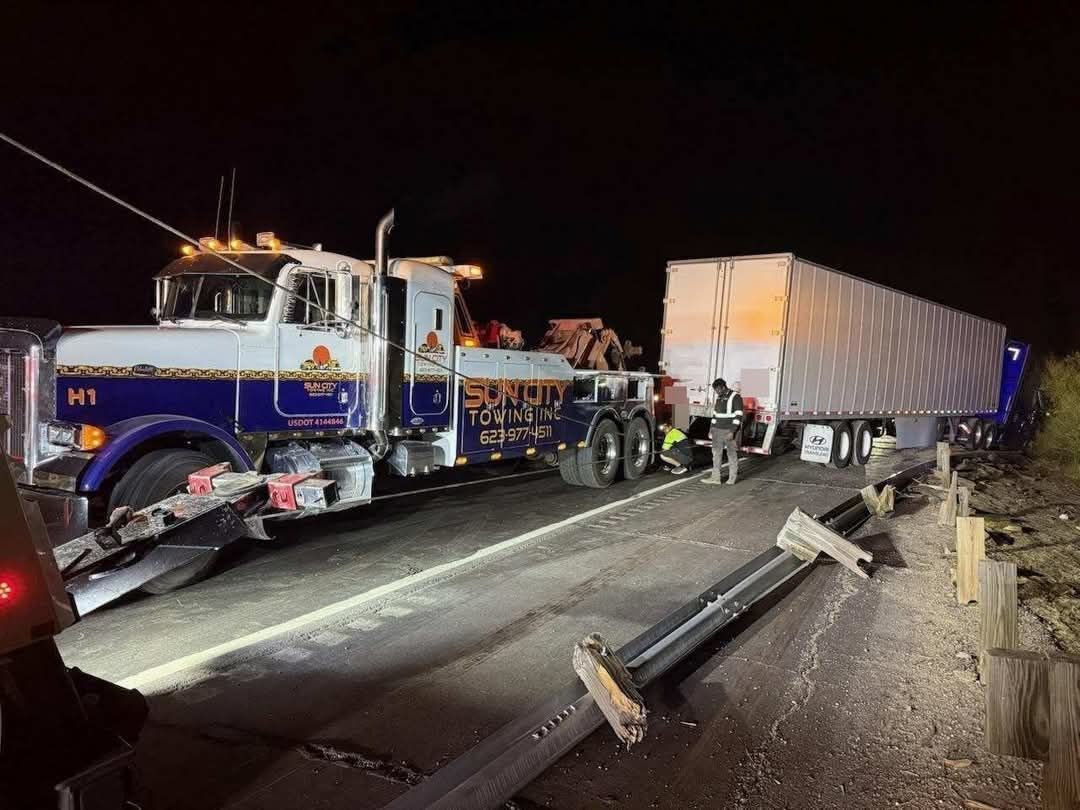
Some disabled commercial vehicles can be moved directly with one of our two heavy wreckers. Others may be better suited for deck transport using the Landoll trailer.
The right choice depends on what happened to the vehicle and how it can be moved. Wheel, axle, suspension, steering, drivetrain, or collision damage may affect whether a vehicle can roll, steer, or be lifted safely.
Landoll towing may be considered when a commercial vehicle needs to remain fully supported during transport or when conventional towing is not the preferred method. A winch can help load a non-running vehicle, but the vehicle must still be evaluated for clearance, securement, weight, and overall stability.
When recovery work is required before transportation, our team may use a heavy wrecker to reposition or recover the vehicle and then use the Landoll to complete the move. This is why the Landoll complements our heavy wrecker service rather than replacing it.
Landoll Trailer vs. Heavy Wrecker Towing
A heavy wrecker and a Landoll trailer serve different purposes.
Our two heavy wreckers are designed for demanding heavy-duty towing and recovery assignments involving tractor-trailers, buses, RVs, commercial trucks, semi-trailers, and other large vehicles. They may be used to lift, tow, winch, upright, or recover heavy vehicles.
A Landoll trailer is primarily used to load and transport an item on a supporting deck. It is often appropriate for machinery, containers, equipment, and certain vehicles that benefit from a low loading angle.
A heavy wrecker may be the better option when a tractor-trailer is disabled along a roadway and can be safely towed. A Landoll may be more appropriate when a non-running machine must be moved between jobsites or a container needs to be relocated.
Some assignments require both. The heavy wrecker can address the recovery portion, while the Landoll handles the transportation portion after the load is positioned for loading.
How Is a Landoll Different From a Flatbed?
Both Landoll trailers and flatbed tow trucks provide deck-supported transport, but they are not interchangeable.
A conventional flatbed is commonly used for passenger vehicles, light-duty trucks, and other vehicles that fit its deck and weight limits. A Landoll trailer is generally designed for larger, longer, heavier, or more difficult-to-load equipment.
The traveling axle is a key difference. Moving the axle changes the trailer’s balance and allows the deck to tilt toward the ground. This creates a loading angle that can accommodate certain low-clearance machines and heavy loads.
A wheel-lift tow truck works differently from both. It lifts one end of a vehicle by its wheels while the other wheels remain on the road. Wheel-lift towing is generally intended for lighter vehicle assignments rather than container or heavy-equipment transport.
Did You Know?
The name “Landoll” has become widely associated with traveling-axle trailers, much like certain brand names become common shorthand for an entire type of product. Landoll identifies towing and recovery, construction, heavy-equipment hauling, rentals, and storage containers among the industries that use this ground-loading design.
Sun City Towing Inc. has provided towing and heavy wrecker services since 1976. Our current fleet supports light-, medium-, and heavy-duty assignments and includes two heavy wreckers in addition to the Landoll, flatbeds, and wheel-lift equipment.
Those figures help illustrate why equipment selection matters. A trailer category may include a broad range of potential capacities, but the exact model, load distribution, road conditions, and configuration determine what a specific unit can transport. That is why we confirm job details instead of applying a general capacity figure to every request.
Planning a Landoll Transport Job
A smoother move usually begins with clear information. When you contact us, be ready to describe the item and where it is located.
Helpful details include the equipment or container type, manufacturer and model when available, estimated weight, length, width, height, operating condition, pickup address, destination, and any access restrictions.
Photos are especially useful. Images can show the condition of the load, available clearance, surface type, loading direction, nearby obstacles, and whether attachments are installed. They also help us identify questions that might otherwise arise after the truck arrives.
The site itself matters as much as the load. A Landoll and its tow vehicle require room to approach, align, load, turn, and depart. A narrow residential driveway may present different challenges from an open construction yard. A container positioned between two buildings may require more planning than one located in an unobstructed lot.
Landoll Transport Across Phoenix and Arizona
Sun City Towing Inc. is based at 7001 W Southern Ave in Laveen. We provide towing and transport services throughout the Phoenix Metro area and Maricopa County, with statewide Arizona service available for qualifying heavy wrecker and Landoll assignments.
The distance of the move is only one part of planning. We also consider the item being transported, road access, pickup conditions, destination conditions, loading requirements, and scheduling needs.
Whether the job involves relocating construction equipment across the Valley, moving machinery to a repair facility, transporting a container, or moving a disabled commercial vehicle, our team will determine whether the Landoll is appropriate before scheduling the assignment.
Request Landoll Trailer Transport
When equipment, machinery, a container, or a disabled commercial vehicle needs more than a standard tow, the right trailer can make the move more manageable.
Sun City Towing Inc. can review the load, access conditions, destination, and transport requirements to determine whether our Landoll, one of our two heavy wreckers, or another truck from our fleet is appropriate. Call
(623) 977-4511 to discuss your Landoll trailer transport needs in Phoenix, Maricopa County, or elsewhere in Arizona.
frequently asked questions
What is Landoll towing?
Landoll towing uses a traveling-axle trailer with a tilting deck to load and transport equipment, containers, machinery, and certain disabled vehicles.
Is a Landoll the same as a heavy wrecker?
No. A heavy wrecker is used for heavy-duty towing and recovery, while a Landoll supports the load on a trailer deck during transport.
Can a Landoll move construction equipment?
Yes, depending on the machine’s weight, dimensions, condition, attachments, clearance, and available access at both locations.
Can you move a storage container with the Landoll?
Our Landoll may be used for certain storage and shipping container moves. We need the container dimensions, approximate weight, condition, and site-access details first.
Does the equipment need to run?
Not always. Non-running equipment may be winched onto the trailer when its condition, clearance, and securement points allow safe loading.
Can a Landoll transport a disabled commercial vehicle?
Yes, certain disabled trucks, buses, motorhomes, and commercial vehicles may qualify for Landoll transport after the vehicle is evaluated.
What information should I provide when requesting service?
Provide the item type, dimensions, estimated weight, condition, pickup and delivery addresses, access details, and clear photographs when possible.
Can you use a heavy wrecker and Landoll on the same job?
Yes. A heavy wrecker may recover or reposition a vehicle or machine before the Landoll transports it to the destination.
How much does Landoll trailer transport cost?
Pricing depends on the load, distance, equipment requirements, access conditions, loading time, and complexity of the move. Contact us with the job details for an estimate.
Is Landoll transport available outside Phoenix?
Qualifying Landoll transport assignments may be available throughout Maricopa County and across Arizona, depending on scheduling and job requirements.